
Should You Self-Manage Your Airbnb? The Hidden Tax Advantages

Hiring a property manager can make owning an Airbnb easier. Someone else handles guest messages, pricing, cleaners, maintenance, and late-night problems.
But before turning over the day-to-day operations, short-term rental owners should understand the potential tax impact.
Self-managing your Airbnb does not automatically create a tax deduction. However, the work you perform may help you satisfy the IRS material participation rules. When combined with a qualifying short-term rental and a cost segregation study, material participation may allow the resulting tax loss to offset wages, business income, or other nonpassive income.
That can make the decision to self-manage much more valuable than simply saving the property management fee.
Why Short-Term Rentals Can Be Different
Rental real estate losses are generally passive. That means the losses typically can only offset income from other passive activities. Any unused losses are usually suspended and carried forward until they can be used in a future year.
However, certain short-term rental activities are treated differently under the passive activity rules.
Under IRS guidance, an activity is not treated as a “rental activity” for these purposes when:
The average customer stay is seven days or less, or
The average customer stay is 30 days or less and significant personal services are provided.
The seven-day test is based on the average period of customer use for the entire year, not the minimum stay shown on your Airbnb listing. Divide the total number of guest-use days by the number of separate rentals to determine the average.
When an activity meets one of these exceptions, it is generally evaluated as a trade or business activity for passive-loss purposes. If the owner also materially participates, the activity may be considered nonpassive. This is commonly called the “short-term rental loophole,” although it is really an application of the existing passive activity rules. IRS Publication 925
How Self-Management Helps Establish Material Participation
Material participation means that you are regularly and meaningfully involved in operating the activity. It is determined each year, so qualifying one year does not guarantee the same treatment in the next.
The IRS provides seven material participation tests. The three most relevant to many Airbnb owners are:
More than 500 hours: You participate in the activity for more than 500 hours during the year.
Substantially all participation: Your work represents substantially all the participation in the activity, including work performed by people who do not own the property.
More than 100 hours and no one participates more: You participate for more than 100 hours and at least as much as any other individual.
Self-managing can make these tests easier to satisfy because the owner is completing much of the work that would otherwise be performed by a property manager.
Potentially qualifying activities may include:
Responding to guests
Managing reservations
Setting and adjusting prices
Coordinating cleaners
Scheduling repairs and maintenance
Purchasing and restocking supplies
Managing vendors
Inspecting the property
Handling permits and licensing
Maintaining the listing
Performing day-to-day bookkeeping
Resolving guest complaints
Work performed by a spouse generally counts toward the owner’s participation, even if the spouse does not own the property. However, simply reviewing financial statements or monitoring the investment without involvement in day-to-day operations generally does not count.
Why Hiring a Property Manager Can Change the Analysis
Hiring a property manager does not automatically make the activity passive. An owner can still materially participate while using outside help.
However, it can make some of the material participation tests harder to satisfy.
For example, assume you spend 120 hours managing your Airbnb, but your property manager spends 200 hours. You would not satisfy the test requiring more than 100 hours and participation at least equal to that of any other person.
The “substantially all” test may also become difficult when a manager or co-host handles most guest communication, pricing, maintenance coordination, and operational decisions.
Cleaners, maintenance workers, co-hosts, and property managers are included when evaluating the participation of everyone involved in the activity. Owners should not assume they qualify simply because they exceeded 100 hours.
Material Participation and Passive Losses
The difference between passive and nonpassive treatment becomes especially important when the property generates a large tax loss.
Consider an owner who earns $200,000 from a W-2 job and purchases an Airbnb. After deducting operating expenses, interest, and accelerated depreciation, the property creates a $150,000 tax loss.
If the activity is passive, that loss generally cannot offset the owner’s salary unless the owner has sufficient passive income or qualifies for another exception. The unused amount may be suspended.
If the property meets a short-term rental exception and the owner materially participates, the loss may be nonpassive and potentially available to offset W-2 wages or other business income.
The deduction may still be limited by:
Tax basis
At-risk rules
Excess business loss limitations
Personal use of the property
Other facts specific to the taxpayer
Material participation is therefore an important part of the analysis, but it is not the only requirement.
How Bonus Depreciation Fits Into the Strategy
Self-management does not determine whether property qualifies for bonus depreciation.
Instead, self-management may affect whether the loss created by depreciation can be used currently.
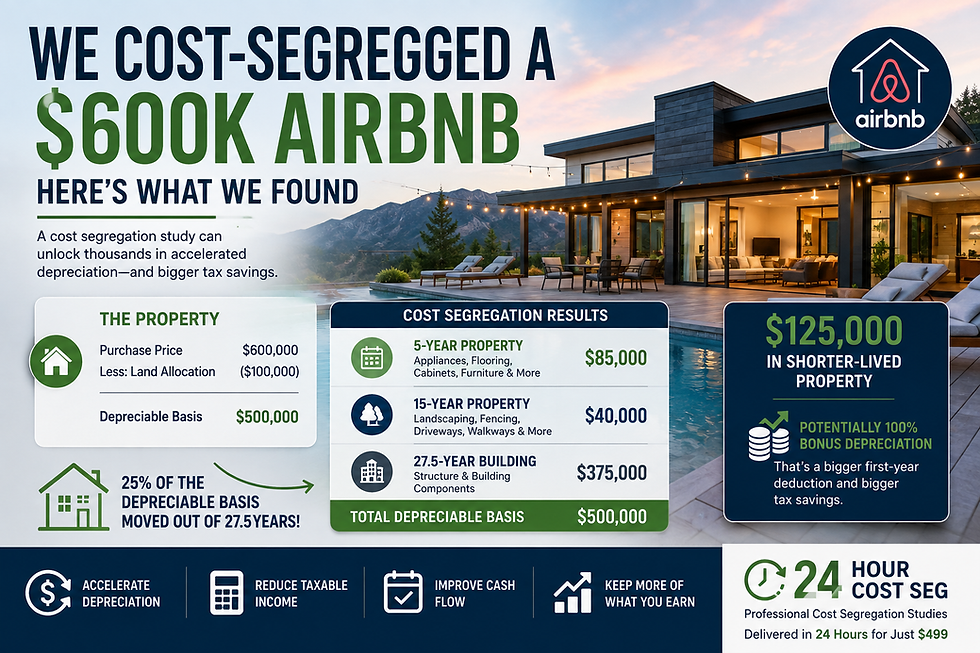
A cost segregation study identifies portions of a property that may qualify for shorter depreciation periods, including certain:
Furniture and appliances
Flooring and decorative finishes
Specialty electrical components
Cabinets and millwork
Landscaping
Fencing
Parking areas
Outdoor lighting
Other land improvements
Many components classified as 5-year, 7-year, or 15-year property may qualify for bonus depreciation. The building itself generally remains depreciable over its longer recovery period.
Current law provides a permanent 100% bonus depreciation deduction for qualifying property acquired after January 19, 2025. Eligibility depends on the property, acquisition date, placed-in-service date, and other requirements. IRS bonus depreciation guidance
This creates an important planning sequence:
Confirm that the activity meets a short-term rental exception.
Determine whether the owner materially participates.
Complete a cost segregation study.
Apply bonus depreciation to eligible components.
Determine whether the resulting loss can offset other income.
Ordering a cost segregation study without first considering the passive activity rules may create a large deduction that is suspended rather than immediately usable. The deduction is not necessarily lost, but the timing of the tax benefit may be different than expected.
Recordkeeping Is Critical
Self-managing helps establish participation only if you can support the work performed.
The IRS allows taxpayers to prove participation using any reasonable method. A calendar, appointment book, activity log, or narrative summary may be acceptable.
However, reconstructing an entire year after receiving an audit notice is much less persuasive than maintaining records throughout the year.
A strong participation log should include:
Date
Task performed
Time spent
Property involved
Supporting documentation
Supporting records might include:
Airbnb or VRBO messages
Emails with cleaners and contractors
Maintenance invoices
Supply receipts
Mileage logs
Pricing-change histories
Calendar entries
Inspection records
Bookkeeping reports
Avoid vague entries such as “managed property, 8 hours.” A more credible entry would be:
June 12: Responded to guest messages, coordinated HVAC repair, updated weekend pricing, reviewed cleaner photos, and ordered replacement linens — 2.3 hours.
The IRS specifically states that investor-level activities, such as reviewing financial reports without participating in day-to-day management, generally do not qualify. IRS material participation rules
Additional Tax Planning Opportunities
Self-managing an Airbnb may also create opportunities to improve the property’s overall tax strategy.
Time major purchases carefully
Furniture, appliances, security systems, and other qualifying assets placed in service before year-end may generate additional depreciation deductions.
Track improvements separately
Repairs and improvements are treated differently for tax purposes. Maintain invoices and photographs showing what was replaced, renovated, or added.
Monitor average guest stays
A small number of extended stays can push the property’s average rental period above seven days. Review the average throughout the year instead of waiting until tax preparation.
Limit personal use
Personal use can restrict rental deductions. Vacation days at the property should be tracked separately from legitimate workdays, although the facts surrounding each visit matter.
Coordinate the cost segregation study with tax planning
The largest possible first-year deduction is not always the best answer. Consider current income, anticipated future income, suspended losses, the planned holding period, and potential depreciation recapture.
Watch the Schedule C issue
Providing substantial guest services, such as regular cleaning during a stay, linen changes, or maid-type services, may cause the activity to be reported on Schedule C and could create self-employment tax considerations. Ordinary services such as utilities, trash collection, and cleaning between guests generally do not by themselves produce the same result. IRS Publication 527
Should You Self-Manage?
Self-management may make sense when:
You have the time and systems to manage the property effectively
You need additional participation hours
You want direct control over pricing and guest experience
A cost segregation study is expected to create a significant tax loss
You can maintain reliable records of your work
Hiring a manager may still be the better business decision if self-management would hurt occupancy, guest satisfaction, or your ability to focus on a more profitable business.
Tax savings should be considered alongside the value of your time. Paying a management fee to generate stronger revenue and regain hundreds of hours may be worth more than qualifying for nonpassive treatment.
The Bottom Line
The hidden tax advantage of self-managing an Airbnb is not a special deduction for doing the work yourself. It is the opportunity to establish material participation.
For owners whose average guest stay meets a short-term rental exception, material participation may convert an otherwise passive activity into a nonpassive activity. When combined with cost segregation and bonus depreciation, that distinction can determine whether a large rental loss is usable now or suspended for the future.
Before making the decision, evaluate the entire strategy:
Does the property meet the short-term rental exception?
Who performs the operational work?
Which material participation test could you satisfy?
Do you have records supporting your hours?
Will a cost segregation study create a usable tax benefit?
Are other loss limitations applicable?
Wondering how much depreciation your Airbnb may be missing? 24 Hour Cost Seg provides fast, CPA-ready cost segregation studies designed to identify qualifying property and help your tax professional evaluate the potential benefit. Request a free estimate before year-end so you have time to coordinate the study with your overall tax strategy.
This article is intended for general educational purposes and is not individualized tax advice. Short-term rental taxation depends on average guest stays, participation, services provided, ownership structure, personal use, and other facts. Consult a qualified tax professional before implementing a strategy.


Comments