
Landscaping, Fences, Driveways, and Pools: The Overlooked Cost Seg Deductions

When most real estate investors think about depreciation, they think about the building.
But some of the most interesting cost segregation opportunities may actually be outside the building.
Driveways. Fences. Landscaping. Sidewalks. Outdoor lighting. Retaining walls. And yes—even swimming pools.
These improvements can represent a meaningful portion of a property's total cost, yet they're easy to overlook when investors think about depreciation.
That's where cost segregation comes in.
The Problem With Standard Depreciation
When you purchase a residential rental property, the portion of the purchase price allocated to the building is generally depreciated over 27.5 years. Commercial buildings are generally depreciated over 39 years.
That's a long time to recover your investment.
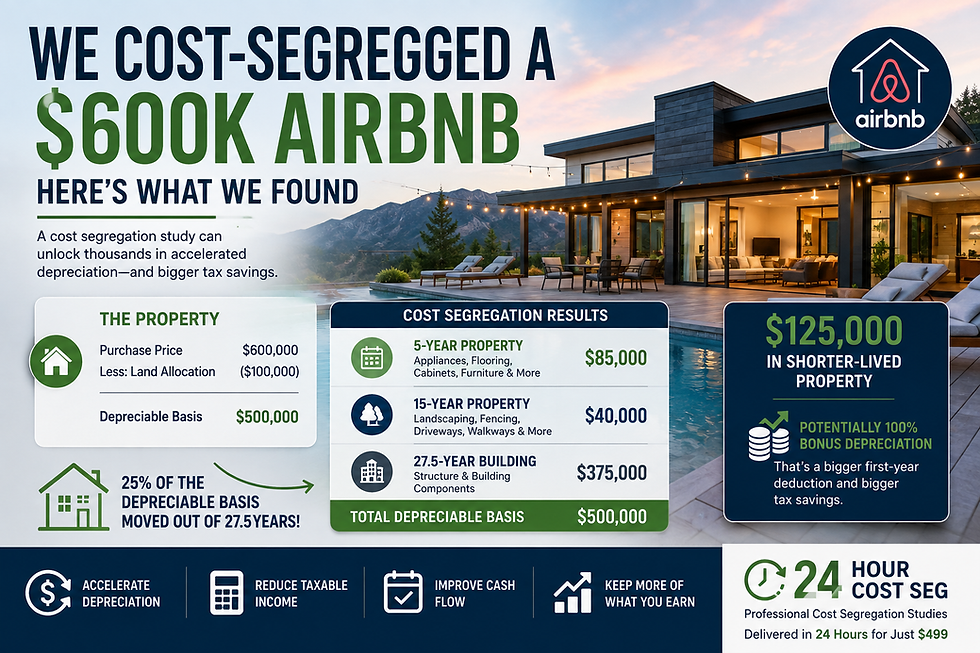
A cost segregation study takes a closer look at the components of the property and identifies assets that may qualify for shorter recovery periods.
Instead of treating virtually everything as part of the building, certain assets may be classified as 5-year, 7-year, or 15-year property.
And some of the easiest assets to overlook are land improvements, which generally have a 15-year recovery period when properly classified.
1. Landscaping
Land itself isn't depreciable.
But that doesn't mean everything sitting on the land is nondepreciable.
Certain landscaping costs associated with a rental property may qualify as depreciable land improvements depending on their nature and relationship to the income-producing property.
Potential examples can include:
Shrubs and ornamental plants
Certain trees
Irrigation systems
Landscape lighting
Decorative landscaping features
Some grading associated with depreciable improvements
The distinction matters.
If a portion of the property's acquisition cost can properly be allocated to depreciable land improvements rather than nondepreciable land or the building, that amount may be recovered much faster.
2. Fences
Have a fenced backyard around your rental?
A privacy fence around an Airbnb?
Decorative fencing around an apartment or commercial property?
Fencing is a classic example of an asset that may qualify as a 15-year land improvement rather than being depreciated over the life of the building.
Consider a rental property with $20,000 of qualifying fencing.
Under 27.5-year straight-line depreciation, recovering that cost would take nearly three decades if it were treated as part of the residential building.
Properly classified as 15-year property, the depreciation schedule becomes considerably shorter—and current bonus-depreciation rules may make the timing difference even more significant when the requirements are satisfied.
3. Driveways and Parking Areas
Concrete and asphalt are easy to ignore.
But they can represent substantial value.
Depending on the property, qualifying exterior improvements may include:
Driveways
Parking lots
Parking pads
Curbs
Exterior sidewalks
Certain paved walkways
These assets may qualify as 15-year land improvements.
This can be particularly significant for properties with large parking areas, long driveways, multiple structures, or extensive exterior hardscaping.
A $500,000 rental with a basic driveway may have a relatively modest allocation.
A $1.5 million vacation property with extensive concrete, parking, retaining walls, fencing, and landscaping could have a much larger opportunity.
That's why cost segregation is property-specific.
4. Swimming Pools
Pools are especially interesting.
For many vacation rentals and short-term rentals, the pool isn't simply decorative—it's an important amenity used to attract guests and generate rental income.
Depending on the facts and construction, various pool-related costs may potentially qualify for shorter depreciation lives than the building itself.
These could include portions associated with:
The swimming pool
Pool decking
Fencing
Exterior lighting
Certain equipment
Landscaping surrounding the pool
Other qualifying site improvements
The exact classification depends on the nature of each asset, which is precisely why a detailed cost segregation analysis can be valuable.
For an Airbnb or vacation rental with a significant pool and outdoor entertainment area, these components can add up quickly.
Why 15-Year Property Is Particularly Important
Here's where cost segregation becomes especially interesting.
Under current federal law, certain qualifying depreciable property with a recovery period of 20 years or less can be eligible for 100% bonus depreciation when acquired and placed in service after January 19, 2025, subject to the applicable requirements and limitations.
That includes many assets identified through cost segregation as 5-, 7-, and 15-year property.
So identifying $40,000 of qualifying land improvements doesn't necessarily mean simply depreciating $40,000 over 15 years.
Depending on the taxpayer's circumstances, those assets may potentially qualify for a much larger first-year depreciation deduction.
A Simple Example
Suppose you purchase a vacation rental and a cost segregation study identifies:
Asset | Allocated Cost |
Fencing | $12,000 |
Driveway & exterior concrete | $18,000 |
Landscaping & irrigation | $10,000 |
Pool-related qualifying improvements | $35,000 |
Total | $75,000 |
Without a cost segregation analysis, some or all of those costs might remain embedded in broader property classifications.
With a properly prepared study, qualifying components can be separately identified and assigned to the appropriate recovery periods.
If the $75,000 is eligible 15-year property and all requirements for 100% bonus depreciation are met, the taxpayer could potentially deduct the entire $75,000 in the first year.
That's a very different result from recovering the cost over decades.
What If You Already Own the Property?
Here's another misconception:
You don't necessarily have to perform a cost segregation study in the year you purchase the property.
If you've owned a rental for several years and have been depreciating the property without a cost segregation study, it may still be possible to perform one now.
In many situations, taxpayers can use an accounting method change—generally involving Form 3115—to calculate and claim previously allowable depreciation without amending every prior-year tax return.
This is commonly referred to as a catch-up depreciation adjustment.
So if you purchased a property several years ago and never considered the value of the driveway, fence, pool, landscaping, or other qualifying components, the opportunity may not necessarily be lost.
Don't Forget the Outdoor Improvements
Cost segregation isn't just about cabinets, flooring, appliances, and electrical systems inside a building.
Sometimes the overlooked tax savings are sitting right outside the front door.
If your rental property has substantial:
Landscaping. Fencing. Driveways. Parking. Sidewalks. Outdoor lighting. Retaining walls. Pools.
…it may be worth taking a closer look.
At 24 Hour Cost Seg, we specialize in cost segregation studies for residential rental properties under $2 million.
Our studies are designed to identify qualifying components of your property and provide the depreciation schedules your CPA needs to properly report the results.
Flat fee: $499 24-hour turnaround.
Because your rental property shouldn't have to wait 27.5 years for every depreciation deduction.
This article is for general educational purposes and is not tax, legal, or accounting advice. Cost segregation classifications, bonus depreciation eligibility, passive activity limitations, depreciation recapture, and other tax consequences depend on the taxpayer's individual facts and circumstances. Consult your tax professional regarding your specific situation.


Comments