
We Cost-Segged a $600K Airbnb. Here’s What We Found
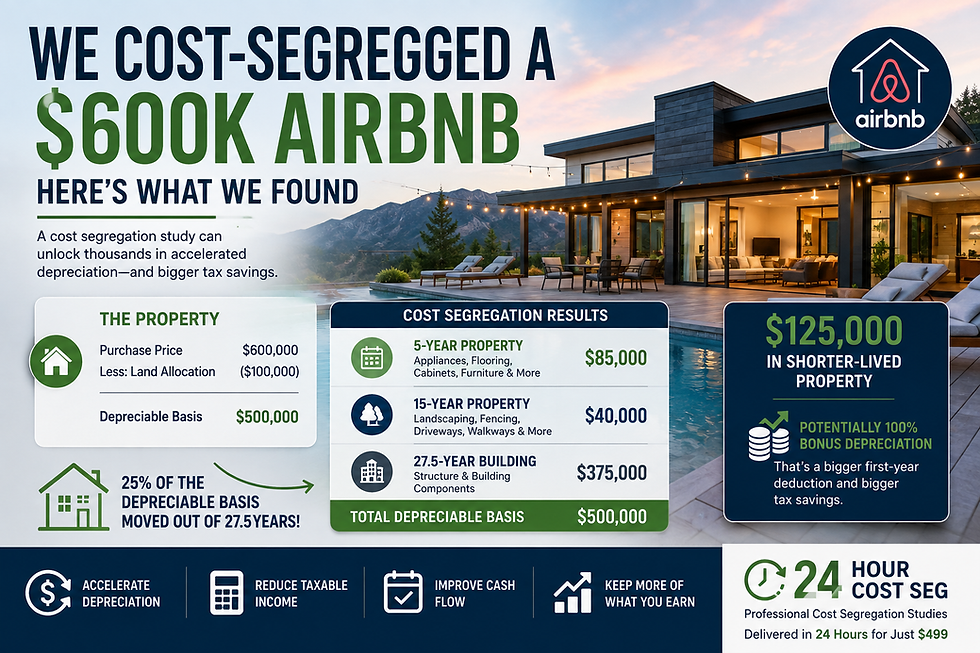
What can a cost segregation study actually do for a $600,000 Airbnb?
Let’s run the numbers.
For this example, we’ll look at a hypothetical investor who purchases a $600,000 short-term rental, places it in service, and completes a cost segregation study.
The results might surprise you.
The Property
Assume our investor purchases a furnished Airbnb for:
Purchase price: $600,000
Before calculating depreciation, we first need to account for something that cannot be depreciated: land.
For this example, assume $100,000 of the purchase price is allocated to land.
That leaves:
Amount | |
Purchase Price | $600,000 |
Less: Land | ($100,000) |
Depreciable Basis | $500,000 |
Without cost segregation, most of that $500,000 building basis would generally be depreciated over 27.5 years as residential rental property.
But a house isn't really one asset.
It's made up of hundreds of individual components.
That's where cost segregation comes in.
We Cost-Segged the Property
A cost segregation study examines the individual components of the property and determines whether certain assets qualify for shorter depreciation lives.
For our hypothetical $600,000 Airbnb, assume the study produces the following allocation:
Classification | Amount |
5-Year Property | $85,000 |
15-Year Property | $40,000 |
27.5-Year Building | $375,000 |
Total Depreciable Basis | $500,000 |
That means:
$125,000 of the property's basis was moved out of 27.5-year depreciation.
Instead, those assets can potentially be depreciated much faster.
That's 25% of the depreciable basis.
What Did We Find?
The shorter-lived assets could include items such as:
5-Year Property
Depending on the facts and construction of the property, this category might include qualifying:
Appliances
Certain flooring
Decorative lighting
Window treatments
Certain cabinetry and millwork
Furniture and furnishings
Specialty electrical components
Other qualifying personal property
15-Year Property
Potential land improvements could include qualifying:
Fencing
Landscaping
Outdoor lighting
Walkways
Driveways or parking areas
Certain patios
Retaining walls
Drainage improvements
The specific classification of every asset depends on the property and applicable tax rules, which is why a cost segregation study should analyze the actual building rather than simply applying a percentage to the purchase price.
Why Does This Matter?
Without cost segregation, the investor generally depreciates the $500,000 basis primarily over 27.5 years.
Ignoring partial-year conventions for a moment, that's roughly:
$500,000 ÷ 27.5 = $18,182 per year
Cost segregation changes the timing.
Instead of waiting decades to recover the cost of certain components, the investor may be able to depreciate them over 5 or 15 years—and some qualifying property may also be eligible for bonus depreciation.
And under current federal law, qualifying property acquired and placed in service after January 19, 2025 may generally qualify for 100% bonus depreciation.
That's where the numbers can get interesting.
What If the $125,000 Qualifies for Accelerated Depreciation?
In our example, the cost segregation study identified:
$85,000 of 5-year property
plus
$40,000 of 15-year property
for a total of:
$125,000 of shorter-lived property
If those assets meet the requirements for 100% bonus depreciation, the investor could potentially deduct that $125,000 immediately, rather than recovering it over 27.5 years.
The remaining $375,000 building basis would continue to be depreciated under the normal residential rental property rules.
That can produce a dramatically larger first-year depreciation deduction.
What Could a $125,000 Deduction Be Worth?
Here's where investors should distinguish between a tax deduction and actual tax savings.
A $125,000 deduction doesn't mean the IRS sends you a $125,000 check.
It reduces taxable income, assuming the investor can actually use the loss.
For example:
Marginal Federal Tax Rate | Potential Federal Tax Value of $125K Deduction* |
24% | $30,000 |
32% | $40,000 |
35% | $43,750 |
37% | $46,250 |
*Simplified illustration only. Actual tax savings depend on the taxpayer's circumstances, ability to deduct losses, state taxes, depreciation conventions, other depreciation deductions, and numerous other factors.
Now compare that potential tax benefit with the cost of completing the study.
That's why cost segregation has become increasingly popular with smaller real estate investors, not just owners of $10 million apartment complexes.
But There's a Catch
Generating a $125,000 deduction and using a $125,000 deduction are two different things. Rental real estate losses are generally subject to the passive activity rules.
If the investor generates a large depreciation loss but can't currently deduct that loss against other income, the tax benefit may be suspended and carried forward.
However, short-term rentals can present a very different planning opportunity.
Why Being an Airbnb Matters
The phrase “Airbnb tax loophole” gets thrown around frequently on social media.
The actual tax rules are more nuanced.
Certain short-term rental activities may not be treated as rental activities for purposes of the passive activity rules if the average customer stay meets specific requirements.
If the activity falls outside the rental-activity definition and the taxpayer materially participates, losses from the property may potentially be treated as nonpassive.
That can be extremely valuable for a high-income taxpayer.
Depending on the circumstances, a qualifying investor may potentially use losses generated by cost segregation against income from other sources.
But simply owning an Airbnb does not automatically make the losses deductible against your salary.
Material participation matters.
The 100-Hour Rule Everyone Talks About
One potential way to establish material participation is for the taxpayer to participate in the activity for more than 100 hours during the year and at least as much as any other individual.
But that's only one of several material-participation tests.
And the details matter.
For example, an investor who spends 110 hours managing the property while a property manager spends 300 hours generally has a very different fact pattern from an owner who personally manages the property for 150 hours and no one else participates more.
This is why short-term rental investors should track their participation contemporaneously.
Don't try to recreate an entire year's worth of hours when your CPA asks about them the following April.
Put the Pieces Together
Now imagine our hypothetical investor:
Buys an Airbnb for $600,000
Allocates $100,000 to land
Has a $500,000 depreciable basis
Completes a cost segregation study
Identifies $125,000 of shorter-lived property
Qualifies for available bonus depreciation
Meets the applicable short-term rental rules
Materially participates in the activity
Has sufficient basis and otherwise qualifies to deduct the resulting loss
Suddenly, a $600,000 real estate purchase can generate a potentially significant current-year tax deduction.
That's the strategy investors are talking about.
But notice how many steps there are between:
“I bought an Airbnb.”
and:
“I can deduct this loss against my other income.”
Cost segregation is one piece of the strategy—not the entire strategy.
What If You Already Own the Airbnb?
You may still have an opportunity.
Cost segregation isn't necessarily limited to properties purchased this year.
An investor who purchased a rental property in a prior year and depreciated the entire building over 27.5 years may potentially complete a look-back cost segregation study.
Depending on the circumstances, Form 3115 and an accounting method change may allow the taxpayer to claim previously missed depreciation without amending several years of tax returns.
This can sometimes create a substantial catch-up depreciation deduction in the current year.
So if you've owned your Airbnb for several years, don't automatically assume you missed your chance.
What Happens When You Sell?
Accelerated depreciation isn't free money.
Cost segregation generally changes the timing of deductions, and selling the property can trigger depreciation recapture and other tax consequences.
That doesn't necessarily make cost segregation a bad strategy.
A dollar of tax deduction today can be significantly more valuable than the same deduction received 10 or 20 years from now.
Investors may also consider strategies such as a 1031 exchange when disposing of investment real estate.
The key is evaluating the entire investment lifecycle—not just maximizing this year's deduction.
Is Cost Segregation Worth It on a $600,000 Airbnb?
Potentially, absolutely.
Historically, one of the biggest obstacles for smaller investors was simply the cost of obtaining a professional cost segregation study.
When a study costs several thousand dollars, the economics may not work well on a $400,000, $500,000, or $600,000 rental property.
That's exactly the market 24 Hour Cost Seg was designed to serve.
For $499, investors can obtain a professional cost segregation study for qualifying residential investment properties without spending thousands of dollars.
The Bottom Line
Our hypothetical $600,000 Airbnb started with:
$500,000 of depreciable basis.
A cost segregation study identified:
$125,000 of shorter-lived property.
Instead of depreciating that entire amount over 27.5 years, the investor may be able to accelerate a significant portion of those deductions.
And when cost segregation is combined with the right short-term rental fact pattern, material participation, and proper tax planning, the results can become even more powerful.
The lesson isn't that every $600,000 Airbnb automatically creates a six-figure tax deduction.
It's this:
If you own investment real estate, you should know what's actually inside your depreciation schedule.
You might be depreciating assets over 27.5 years that the tax code allows you to recover much faster.
What Could Your Property Look Like?
Own an Airbnb, VRBO, vacation rental, or other residential investment property?
24 Hour Cost Seg provides professional cost segregation studies for $499, typically delivered within 24 hours.
Find out how much of your property's basis may qualify for accelerated depreciation.
Get started at 24HourCostSeg.com.
This example is hypothetical and provided for educational purposes only. Actual cost segregation results vary substantially based on the property, land allocation, construction, improvements, acquisition date, placed-in-service date, and other facts. Tax treatment also depends on the taxpayer's individual circumstances. This article is not intended as tax, legal, or investment advice. Consult your tax advisor regarding your specific situation.


Comments