
7 Smart Tax Moves Every Airbnb Owner Should Make Before Year-End
Owning an Airbnb can create valuable tax deductions, but many of the best planning opportunities disappear once December 31 passes.

The key is to act before year-end. Buying furniture in January, completing a renovation after the property’s final December guest, or ordering a cost segregation study after filing your return may delay valuable deductions or make planning more complicated.
Here are seven smart tax moves every Airbnb and short-term rental owner should consider before year-end.
1. Purchase Needed Furniture and Equipment
If your Airbnb needs new furniture, appliances, or equipment, consider purchasing and placing those items in service before December 31.
Potential purchases may include:
Beds and mattresses
Sofas and chairs
Televisions
Refrigerators and appliances
Outdoor furniture
Hot tubs
Security systems
Smart locks
Computers and office equipment
Linens, cookware, and guest supplies
The important phrase is placed in service. An item is generally placed in service when it is ready and available for use in the rental activity. Simply ordering furniture or paying a deposit before year-end may not be enough if the items are not delivered, installed, and ready for guests until the following year.
Many furniture and equipment purchases have shorter tax lives and may qualify for accelerated depreciation. Under current law, certain eligible property acquired and placed in service after January 19, 2025, may qualify for 100% bonus depreciation. IRS bonus-depreciation guidance
That does not mean you should spend money solely for a deduction. A $10,000 purchase does not produce $10,000 of tax savings. But if the property already needs an upgrade, completing it before year-end could accelerate the deduction.
2. Finish Renovations and Place Them in Service
Many Airbnb owners schedule renovations during slower months. If you are already improving the property, completing the work before year-end may allow depreciation to begin during the current tax year.
Projects might include:
Replacing flooring
Updating cabinets and countertops
Remodeling bathrooms
Adding outdoor entertainment areas
Installing a pool or hot tub
Improving landscaping
Adding fencing
Constructing parking areas
Installing specialty lighting
Replacing appliances
Adding built-in technology or security systems
As with furniture, paying for a renovation is not necessarily enough. The renovated space generally needs to be completed and available for rental use.
Keep detailed invoices showing the cost of each part of the project. Avoid accepting one invoice that simply says “renovation.” A cost segregation study may classify flooring, cabinets, electrical work, landscaping, fencing, and other components differently.
Detailed records make it easier to determine the correct tax treatment.
Also distinguish between repairs and improvements. A repair that keeps the property in its normal operating condition may be currently deductible. An improvement that better adapts the property, restores it, or materially increases its value may need to be capitalized and depreciated.
Before beginning a large year-end project, ask your tax professional how it is likely to be treated.
3. Reconstruct and Update Your Mileage Log
Short-term rental owners frequently drive for business purposes but fail to document the trips.
Potential business mileage may include travel to:
Inspect the property
Meet contractors
Purchase supplies
Handle maintenance
Replace furniture
Meet cleaners or property managers
Visit a bank, attorney, or tax adviser
Attend qualifying real estate education or business meetings
Whether a particular trip is deductible depends on its purpose, starting location, and the overall facts. Normal commuting is generally nondeductible, and personal travel should be separated from business travel.
Your mileage records should include:
Date of the trip
Starting location
Destination
Business purpose
Total business miles
For 2026, the IRS business mileage rate is 72.5 cents per mile for January 1 through June 30 and 76 cents per mile for July 1 through December 31. The midyear rate change makes accurate trip dates especially important. IRS standard mileage rates
Do not wait until tax season to estimate your mileage. Review calendars, receipts, emails, contractor appointments, and mapping history before the details become difficult to reconstruct.
If you use the actual-expense method instead, gather your fuel, insurance, registration, repair, maintenance, and vehicle-depreciation records. Your tax professional can help determine which method is available and more beneficial.
4. Review Your Retirement Contribution Strategy
A retirement contribution may reduce current taxable income while helping you build long-term wealth.
Depending on your income and business structure, possible options may include:
Traditional IRA
Roth IRA
SEP-IRA
Solo 401(k)
Employer-sponsored 401(k)
SIMPLE IRA
Cash balance or defined benefit plan
For 2026, the basic employee contribution limit for most 401(k) plans is $24,500, with additional catch-up contributions potentially available based on age. The 2026 IRA contribution limit is $7,500, or $8,600 for someone age 50 or older. SEP contributions may be as high as the lesser of 25% of qualifying compensation or $72,000, subject to the applicable calculation and plan rules. IRS retirement-plan limits
However, owning an Airbnb does not automatically make you eligible to fund a retirement plan. Retirement contributions generally require qualifying compensation or earned income. Rental income reported on Schedule E will not ordinarily create retirement-plan compensation by itself.
An owner may still qualify based on W-2 wages, self-employment income from another business, or income from an Airbnb activity properly treated as a trade or business subject to self-employment tax.
Retirement plans also have different establishment, election, and funding deadlines. Discuss your options before December instead of waiting until your tax return is prepared.
5. Recalculate Your Estimated Taxes
A profitable Airbnb can create an unexpected tax bill, particularly if the owner has not adjusted withholding or made estimated tax payments.
Review your year-to-date results, including:
Airbnb and VRBO income
Cleaning fees collected
Direct-booking income
Operating expenses
Mortgage interest
Property taxes
Depreciation
Other business income
W-2 income and withholding
Investment income
Capital gains
Prior estimated tax payments
Most taxpayers can generally avoid an underpayment penalty by paying at least 90% of the current year’s tax or 100% of the prior year’s tax. The prior-year threshold generally increases to 110% for higher-income taxpayers. Other exceptions and special calculations may apply. IRS estimated-tax guidance
The fourth estimated tax payment for a calendar-year individual is generally due January 15 of the following year. However, waiting until January to calculate the liability may leave little time to implement strategies that must be completed by December 31.
If you also receive W-2 wages, increasing year-end withholding can sometimes be an efficient way to address a projected shortfall because withholding is generally treated as paid throughout the year. Discuss this option with your tax professional before the final payrolls are processed.
6. Determine Whether a Cost Segregation Study Makes Sense
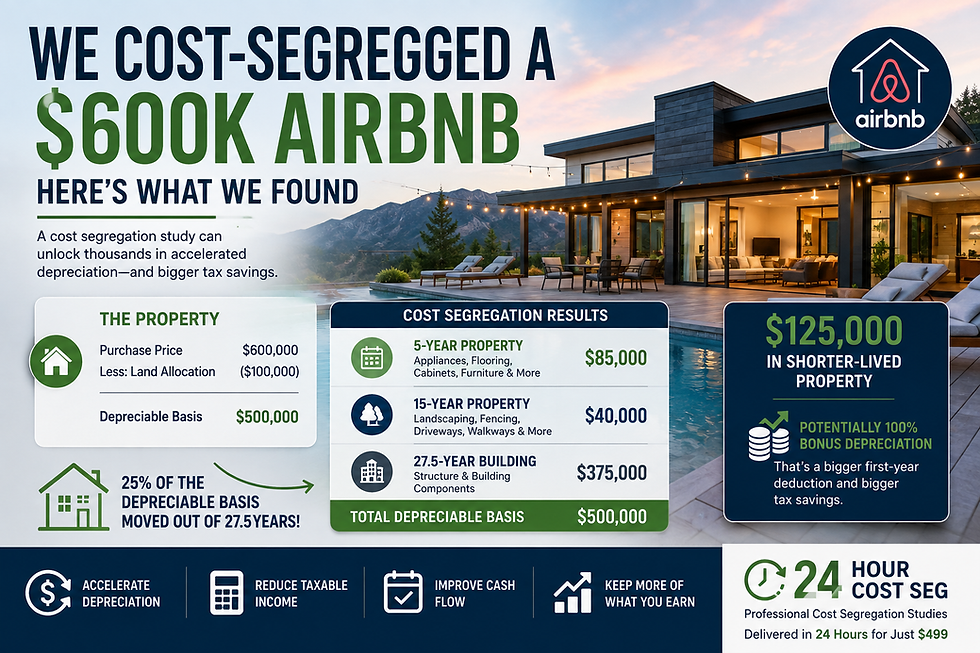
Residential rental buildings are generally depreciated over 27.5 years. However, not every part of an Airbnb is necessarily a 27.5-year asset.
A cost segregation study identifies portions of the property that may qualify for shorter 5-year, 7-year, or 15-year depreciation periods.
Common examples can include:
Appliances
Furniture
Certain flooring and finishes
Decorative lighting
Specialty electrical systems
Cabinets and millwork
Landscaping
Fencing
Driveways and parking areas
Outdoor lighting
Pools and certain site improvements
Once properly classified, eligible shorter-life assets may qualify for accelerated depreciation, including 100% bonus depreciation under current law when the applicable requirements are satisfied.
For example, assume an investor purchases and places an $800,000 Airbnb in service. After allocating value to the land, a cost segregation study identifies $175,000 of qualifying shorter-life property. Depending on the acquisition date and other facts, a substantial portion of that amount could potentially be deducted in the first year rather than spread over 27.5 years.
However, generating a deduction and using a deduction are not the same thing.
Before completing the study, evaluate:
Whether the activity meets the short-term rental exception
Whether the owner materially participates
Whether the losses will be passive or nonpassive
The owner’s tax basis and amount at risk
Personal use of the property
Current and projected taxable income
The anticipated holding period
Potential depreciation recapture at sale
A cost segregation study can still be beneficial when losses are passive, but the deduction may be suspended until the owner has passive income or otherwise becomes eligible to use it.
Owners who purchased property in a prior year may also be able to complete a look-back study and claim catch-up depreciation through an accounting-method change. It may not be too late simply because the property has already appeared on a prior tax return.
7. Schedule a Tax Planning Meeting Before December
The most important year-end tax move may be meeting with your tax professional while there is still time to act.
Tax preparation explains what already happened. Tax planning helps determine what should happen next.
Ideally, schedule your planning meeting in October or November and provide:
Year-to-date profit and loss statement
Prior-year tax return
Current mortgage statement
Closing documents for newly purchased properties
Renovation invoices
Furniture and equipment purchases
Mileage records
Estimated tax payments
Payroll information
Personal-use days
Average guest-stay information
Expected major purchases or property sales
Details of any new properties under contract
Ask your tax professional to model multiple scenarios. For example:
What happens if renovations are completed this year?
Would a cost segregation study create a currently usable loss?
Should additional furniture be purchased now or next year?
Do I materially participate in the rental?
Should I increase withholding or make an estimated payment?
Which retirement plan fits my income and ownership structure?
How will a planned property sale affect depreciation recapture?
The best strategy is not always the one that produces the largest deduction. The goal is to claim deductions when they create the greatest overall benefit.
Your Year-End Airbnb Tax Checklist
Before December 31:
Purchase and place needed furniture in service
Finish planned renovations
Organize invoices by project and asset
Update your mileage log
Review retirement contribution options
Recalculate estimated taxes
Evaluate material participation
Calculate the average guest stay
Review personal-use days
Consider a cost segregation study
Meet with your tax professional
The Bottom Line
Airbnb owners have more tax-planning opportunities than many traditional landlords, but timing and documentation matter.
Furniture must be ready for use. Renovations must be completed. Mileage must be supported. Retirement contributions require eligible compensation. Estimated taxes must be reviewed, and a cost segregation study should be coordinated with the passive activity and material participation rules.
Taking these steps before year-end can help you improve cash flow, avoid surprises, and make sure you are not leaving valuable deductions on the table.
Wondering whether your Airbnb could benefit from accelerated depreciation?
24 Hour Cost Seg provides fast, CPA-ready cost segregation studies for short-term rental owners. Request a free estimate to see how much of your property may qualify for accelerated depreciation and whether a study fits into your year-end tax strategy.
This article is intended for general educational purposes and does not constitute individualized tax advice. Tax results depend on the property, ownership structure, participation, income, personal use, and other circumstances. Consult a qualified tax professional before implementing any strategy.


Comments