
Can Your Airbnb Losses Offset Your W-2 Income?
- Jul 28
- 7 min read
For some short-term rental owners, the answer is yes.

An Airbnb can potentially generate a tax loss that offsets income from a salary, business, or other nonpassive source. This opportunity is sometimes called the “short-term rental tax loophole,” but it is not a single deduction or automatic tax break.
To potentially use an Airbnb loss against W-2 income, you generally need to clear two important hurdles:
The property must qualify for an exception to the passive rental rules.
You must materially participate in the activity.
Cost segregation can then help accelerate depreciation and increase the potential loss. Here is how the strategy works.
Why Rental Losses Usually Cannot Offset W-2 Income
The IRS generally treats rental activities as passive. Passive losses can usually offset passive income, but they generally cannot offset wages or other nonpassive income.
For example, assume you earn $250,000 from your job and your long-term rental generates a $40,000 tax loss. If the rental is passive and you have no other passive income, the loss will generally be suspended instead of deducted against your salary.
The suspended loss carries forward and may become deductible when you generate passive income or sell your entire interest in the activity in a qualifying taxable transaction.
There is a special allowance that permits some property owners to deduct up to $25,000 of rental losses against nonpassive income. However, that allowance begins phasing out when modified adjusted gross income exceeds $100,000 and is generally eliminated at $150,000.
For many high-income W-2 earners, this exception provides little or no current benefit.
Short-term rentals can be different.
The Short-Term Rental Exception
Under the passive activity rules, an activity is not treated as a rental activity when the average period of customer use is seven days or less. The rule is based on the property’s average guest stay, not its longest stay and not the fact that it is listed on Airbnb or Vrbo. The average stay is generally calculated by dividing the total number of guest-use days by the number of separate rentals during the year.
For example, if your property had 100 rental stays totaling 500 guest-use days, its average customer stay would be five days.
An activity may also fall outside the rental category when the average customer stay is 30 days or less and the owner provides significant personal services. This is a more fact-specific exception. Routine cleaning between guests and ordinary maintenance generally do not qualify as significant personal services.
If your Airbnb meets one of these exceptions, the activity may be treated as a trade or business rather than a rental activity for purposes of the passive loss rules.
That brings us to the next requirement: material participation.
Material Participation Is the Key
Meeting the short-term rental exception does not automatically make your Airbnb loss deductible against W-2 income. You must also materially participate in the activity.
The IRS has seven material participation tests. The tests most commonly used by short-term rental owners include:
You participate in the activity for more than 500 hours during the year.
Your participation represents substantially all the participation in the activity.
You participate for more than 100 hours, and no other individual participates more than you.
For many Airbnb owners, the 100-hour test is the most practical. However, it includes an important comparison requirement.
You must participate for more than 100 hours and at least as much as any other person. That includes cleaners, property managers, co-hosts, maintenance workers, contractors, and other individuals, whether or not they own part of the property.
This is one reason self-managing an Airbnb may provide an important tax advantage.
What Activities May Count?
Time spent performing ordinary management and operational activities may count toward material participation. Examples include:
Communicating with guests
Managing reservations
Updating the listing
Adjusting prices
Coordinating cleaning and maintenance
Purchasing furniture and supplies
Inspecting the property
Handling bookkeeping
Responding to guest issues
Supervising contractors
Managing insurance and licensing requirements
Investor-type activities generally do not count unless you are directly involved in the activity’s day-to-day management or operations.
Examples of investor activities may include reviewing financial statements, monitoring the property’s overall performance, or arranging financing without additional operational involvement.
Work performed primarily to create enough hours to qualify may also be challenged. Your participation should represent legitimate work necessary to operate the property.
Do You Need to Be a Real Estate Professional?
Not necessarily.
Traditional rental activities are generally passive even when the owner materially participates, unless the owner also qualifies as a real estate professional.
Qualifying as a real estate professional generally requires spending more than 750 hours in real property trades or businesses and spending more than half of your total working time in those activities.
That standard is difficult for someone with a full-time W-2 job to satisfy.
The short-term rental exception changes the analysis. If your Airbnb has an average guest stay of seven days or less, it may not be treated as a rental activity for the passive loss rules.
If you also materially participate, the activity’s loss may be nonpassive without requiring you to qualify as a real estate professional.
This is why the strategy can be especially valuable for physicians, executives, attorneys, business owners, and other high-income professionals.
Where Cost Segregation Fits In
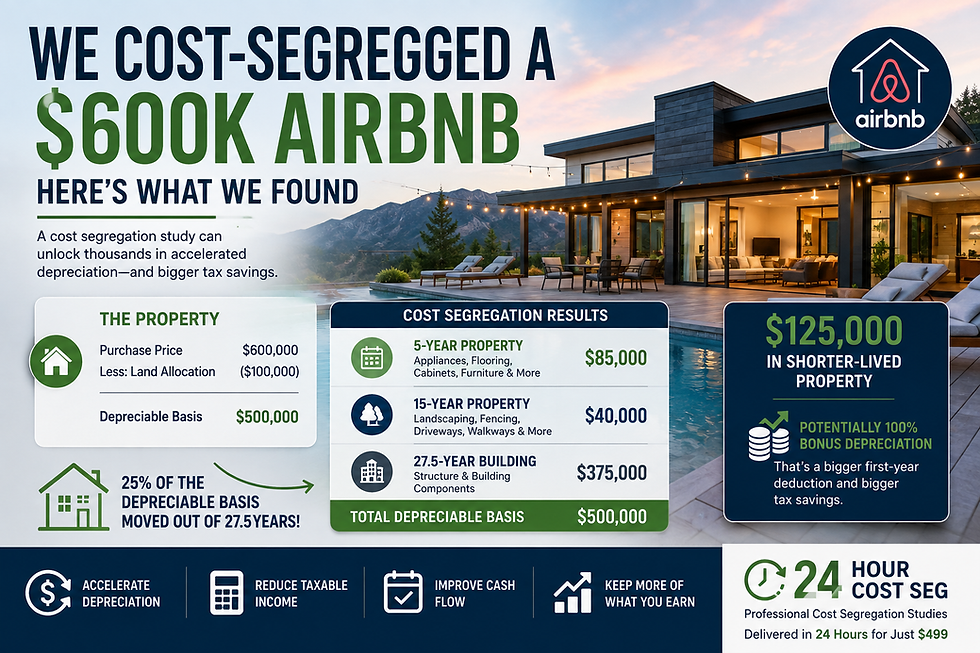
Material participation determines whether an Airbnb loss may be treated as nonpassive. Cost segregation helps determine the timing and size of the property’s depreciation deductions.
A residential rental building is ordinarily depreciated over 27.5 years. A cost segregation study identifies qualifying property components that can be depreciated over shorter recovery periods, commonly 5, 7, or 15 years.
These components may include:
Furniture and appliances
Certain flooring and finishes
Decorative lighting
Cabinets and specialty millwork
Fencing
Landscaping
Sidewalks and patios
Certain electrical and plumbing components
Qualifying shorter-life property may also be eligible for bonus depreciation.
Current federal law generally provides 100% bonus depreciation for eligible property acquired and placed in service after January 19, 2025. Land and the building itself do not qualify, but certain shorter-life components identified through a cost segregation study may qualify.
Accelerating these deductions can create or significantly increase an Airbnb’s tax loss.
If the activity qualifies as nonpassive and the loss is not restricted by another limitation, it may offset W-2 income.
However, cost segregation does not turn a passive activity into a nonpassive activity. If you do not materially participate, a cost segregation study may simply create a larger suspended passive loss.
A Simplified Example
Assume a married couple earns $300,000 in combined W-2 income and purchases an Airbnb during the year.
The property’s average guest stay is five days, so it qualifies for the seven-day exception.
One spouse spends 160 hours managing the property. No cleaner, contractor, property manager, or other individual spends more time on the activity. The spouse therefore satisfies the 100-hour material participation test.
After operating expenses and accelerated depreciation from a cost segregation study, the Airbnb produces a $75,000 tax loss.
Because the property qualifies for the short-term rental exception and the couple materially participates, the loss may be treated as nonpassive. Subject to the basis, at-risk, excess business loss, and other limitations, the loss may offset part of the couple’s W-2 income.
At a hypothetical 35% combined federal tax rate, a fully deductible $75,000 loss could produce approximately $26,250 in federal income tax savings.
This is a simplified example. Actual results depend on the property’s depreciable basis, land allocation, placed-in-service date, ownership structure, financing, personal use, participation records, and the owners’ complete tax situation.
Other Rules Can Still Limit the Loss
Passing the short-term rental and material participation tests is not the end of the analysis. Several other tax rules may limit the deduction.
Basis limitations
If the property is owned through a partnership or S corporation, you generally cannot deduct losses beyond your adjusted tax basis in the entity.
At-risk rules
Your deductible loss may be limited to the amount you have economically at risk in the activity.
Excess business loss limitation
Large nonpassive business losses may be limited at the individual level. The disallowed amount generally carries forward under the applicable rules.
Personal-use limitations
If you use the Airbnb personally for more than the greater of 14 days or 10% of its fair-rental days, the vacation-home rules may limit your ability to deduct a loss.
Placed-in-service requirements
The property must be ready and available for rent before depreciation can begin. Simply purchasing the property before year-end is not necessarily enough.
State tax differences
Some states do not follow the federal bonus depreciation rules, so your state deduction may be different from your federal deduction.
Keep Detailed Participation Records
Material participation is based on what you actually did during the year.
Maintain a participation log that includes:
The date of each activity
The work performed
The time spent
Who performed the work
Supporting documentation
Supporting records may include calendars, guest messages, mileage logs, invoices, emails, maintenance records, bookkeeping reports, and property-management statements.
The IRS does not specifically require a contemporaneous daily time log if participation can be established through other reasonable means. However, a detailed record maintained throughout the year is generally more persuasive than an estimate created during tax preparation or an audit.
If you plan to use the 100-hour test, you should also document how much time cleaners, co-hosts, property managers, and contractors spend working on the activity.
Tracking your own hours is not enough if another individual may have worked more than you.
Plan Before Year-End
The best time to evaluate this strategy is before purchasing the property or early in the tax year.
Before year-end, review:
Your average guest stay
Your participation hours
The hours worked by other individuals
The date the property was ready and available for rent
Your personal-use days
Your projected taxable income
Planned furniture purchases and improvements
Whether cost segregation would create a deduction you can currently use
Year-end planning may give you time to increase your legitimate involvement, place qualifying assets in service, correct recordkeeping problems, and determine whether accelerated depreciation fits your broader tax strategy.
The Bottom Line
Airbnb losses can potentially offset W-2 income when the property qualifies for an exception to the passive rental rules and the owner materially participates.
Cost segregation and bonus depreciation can significantly increase the available deduction, but they do not replace the material participation requirement.
Before ordering a cost segregation study solely to generate a W-2 offset, work with a tax professional who understands short-term rentals, passive activity rules, and accelerated depreciation.
The most important question is not simply, “How large could my deduction be?”
It is, “Can I actually use the deduction this year?”
Want to know how much depreciation your Airbnb may qualify for?
24 Hour Cost Seg provides IRS-compliant residential cost segregation studies for a simple flat fee of $499. Get a CPA-ready report for your residential rental property in as little as 24 hours after we receive the required property information.
This article is for general educational purposes and should not be considered tax, legal, or investment advice. Tax results vary based on individual circumstances. Consult your tax adviser before implementing any tax strategy.


Comments